
Download
Original Article
Effect of budesonide combined with montelukast sodium on pulmonary function parameters and immunoglobulin levels in children with bronchial asthma
Fangfang Chu, Lei Liang*, Fuzhe Chen
Department of Pediatric Respiratory, Anhui Provincial Children’s Hospital, Hefei City, Anhui Province, 230051, China
Abstract
Background and aim: Bronchial asthma is a prevalent type of respiratory disease that affects a large proportion of pediatric patients. The purpose of this study is to further investigate the clinical effects of budesonide combined with montelukast sodium in treating bronchial asthma.
Methods: Eighty six children with bronchial asthma were equally divided into study and control groups via randomized double-blind controlled trial. The control group was treated with aerosol inhalation of budesonide combined with placebo, while the study group was treated with budesonide combined with montelukast sodium. Pulmonary function parameters, immunoglobulin, and recovery of related symptoms, along with the adverse reaction rate, were observed and compared between both groups.
Results: Before treatment, there was no marked difference in pulmonary function parameters and immunoglobulin indexes between both groups (P > 0.05). All pulmonary function indicators and immunoglobulin indexes in both groups improved following therapy, with the study group outperforming the control group (P < 0.05). The recovery time of related symptoms in the study group was shorter than that in the control group (P < 0.05). The incidence of adverse reactions in both groups was compared, with notable differences (P < 0.05).
Conclusion: Budesonide combined with montelukast sodium in the treatment of bronchial asthma has the value of clinical application and promotion.
Key words: budesonide, montelukast sodium, bronchial asthma, pulmonary function, immunoglobulin
*Corresponding author: Lei Liang, Department of Pediatric Respiratory, Anhui Provincial Children’s Hospital, No. 39 Wangjiang East Road, Baohe District, Hefei City, Anhui Province, China. Email address: [email protected]
Received 27 April 2023; Accepted 15 May 2023; Available online 1 July 2023
Copyright: Chu F, et al.
License: This open access article is licensed under Creative Commons Attribution 4.0 International (CC BY 4.0). http://creativecommons.org/licenses/by/4.0/
Introduction
Bronchial asthma has emerged as a common type of respiratory disease. Pediatric patients of bronchial asthma account for a substantial proportion of the patient population, especially infants before the age of 5 years.1 The disease has a distinct pathophysiology relative to other prevalent disorders of the pediatric respiratory system, and it typically manifests clinically as respiratory tract infections, chronic airway inflammation, and airway hyperreactivity.2 The prominent clinical symptoms of bronchial asthma include dyspnea, wheezing, and cough that aggravate or attack in the early morning and night. As found in relevant clinical studies,3,4 leukotrienes play a critical role in the process of airway inflammation in bronchial asthma. Leukotrienes can interact with leukotriene receptors present locally in patients, thereby promoting the convergence of eosinophils. Inhaled corticosteroids are the primary treatment for bronchial asthma at the moment. Budesonide is the most commonly used agent. The drug can effectively repress the development of inflammation, improve smooth muscle spasm, and stimulate the endothelial function to return to normal. However, budesonide has no evident effect on leukotrienes and their receptors during the progression of bronchial asthma.3,5,6 As a result, despite receiving budesonide medication, children did not experience optimal improvement in linked symptoms. Montelukast sodium belongs to a type of leukotriene antagonist that is selective.7–9 It can prevent leukotriene from attaching to receptors, thus regulating inflammation while compensating for budesonide’s limitations.10–12 Therefore, to further investigate the clinical therapeutic effect of budesonide combined with montelukast sodium in bronchial asthma, 86 children with bronchial asthma admitted to our hospital from January 2019 to December 2020 were selected for the following study and report.
Materials and Methods
Clinical data
Eighty six children with bronchial asthma, admitted in our hospital from January 2019 to December 2020, were selected as the main subjects of the present study. They were equally divided into study and control groups by applying a randomized double-blind controlled trial. There was no remarkable difference in clinical baseline data between both groups (P > 0.05), as shown in Table 1. The study is comparable. The Ethics Committee of Anhui Provincial Children’s Hospital (Approval no. EYLL-2022010) approved the study.
Table 1 Clinical Baseline Data.
| Clinical data | Study group (n = 43) | Control group (n = 43) | t/x2 | P |
|---|---|---|---|---|
| Age (year) | 5.21 ± 0.51 | 5.26 ± 0.54 | 0.4414 | 0.6600 |
| FVC (L) | 2.51 ± 0.21 | 2.52 ± 0.23 | 0.2105 | 0.8338 |
| DLCO (mL/min/mmHg) | 17.12 ± 1.62 | 17.19 ± 1.59 | 0.2022 | 0.8402 |
| RV/TLC | 39.21 ± 2.16 | 39.31 ± 2.09 | 0.2182 | 0.8278 |
| Gender (n) | ||||
| Male | 23 | 24 | 0.0469 | 0.8285 |
| Female | 20 | 19 | ||
| Degree of asthma (n) | ||||
| Mild | 25 | 24 | 0.0474 | 0.8276 |
| Severe | 18 | 19 | ||
| Disease duration (years) | 2.51 ± 0.51 | 2.53 ± 0.50 | 0.1836 | 0.8547 |
| Family history (n) | ||||
| Yes | 13 | 14 | 0.0540 | 0.8163 |
| No | 30 | 29 | ||
| History of respiratory infection (n) | ||||
| Yes | 16 | 17 | 0.0492 | 0.8245 |
| No | 27 | 26 | ||
| Obesity (n) | ||||
| Yes | 14 | 15 | 0.0520 | 0.8196 |
Treatment methods
All children received basic treatment including anti--infection and oxygen inhalation. Active symptomatic treatment measures were given according to individual -differences in children.
Inclusion criteria
(1) All of them met the definition and diagnostic criteria for asthma in children in the Guidelines for the Diagnosis and Prevention of Bronchial Asthma in Children; (2) Bronchial provocation test was positive; (3) No previous treatment with glucocorticoids, β2 receptor agonists, and histamines was given to them.
Exclusion criteria
(1) Patients with a history of drug allergy; (2) Patients with severe heart, liver, and kidney dysfunction; (3) Patients with hormone resistance or dependence; (4) Patients with mental disorders.
Control group
The control group was subjected to aerosol inhalation of budesonide [Budesonide suspension (manufacturer: AstraZeneca Pty Ltd., approval number: imported drug registration certificate No. H20140474; strength: 2 mL: 1 mg) + normal saline 2 mL each for mixing] twice daily and 20 min each time. According to the children’s condition, the dose was controlled at 200–800 μg/d. Placebo was also given to the children, and the dosage form and smell of the drug were consistent with those of montelukast sodium tablets.
Study group
Monelukast sodium chewable tablets [manufacturer: Organon Pharma (UK) Limited (packaged by Hangzhou MSD Pharmaceutical Co., Ltd.) State medical permitment number. J20130054; strength: 5 mg] were orally administered based on aerosol inhalation of budesonide (the method was the same as the control group). For children less than 5 years old, the dose was 4 mg once a day; for children 5–10 years old, the dose was 5 mg once a day; and for children 10–15 years old, the dose was 10 mg once a day.
Outcome measures
Pulmonary function parameters (FEV1, FVC, FEV1/FVC, PEF, MMEF, MEF25%, MEF50%, DLCO, RV/TLC), immunoglobulin (IgA, IgG, IgM), and recovery of related symptoms were observed and compared between both groups.
-
Pulmonary function parameters of the children were examined by spirometry.
-
Immunoglobulin (IgA, IgG, IgM, IgE) was measured by immunonephelometry.
-
The disappearance time of wheezing, wheezing rale, cough, and dyspnea was recorded.
-
Adverse reactions were recorded.
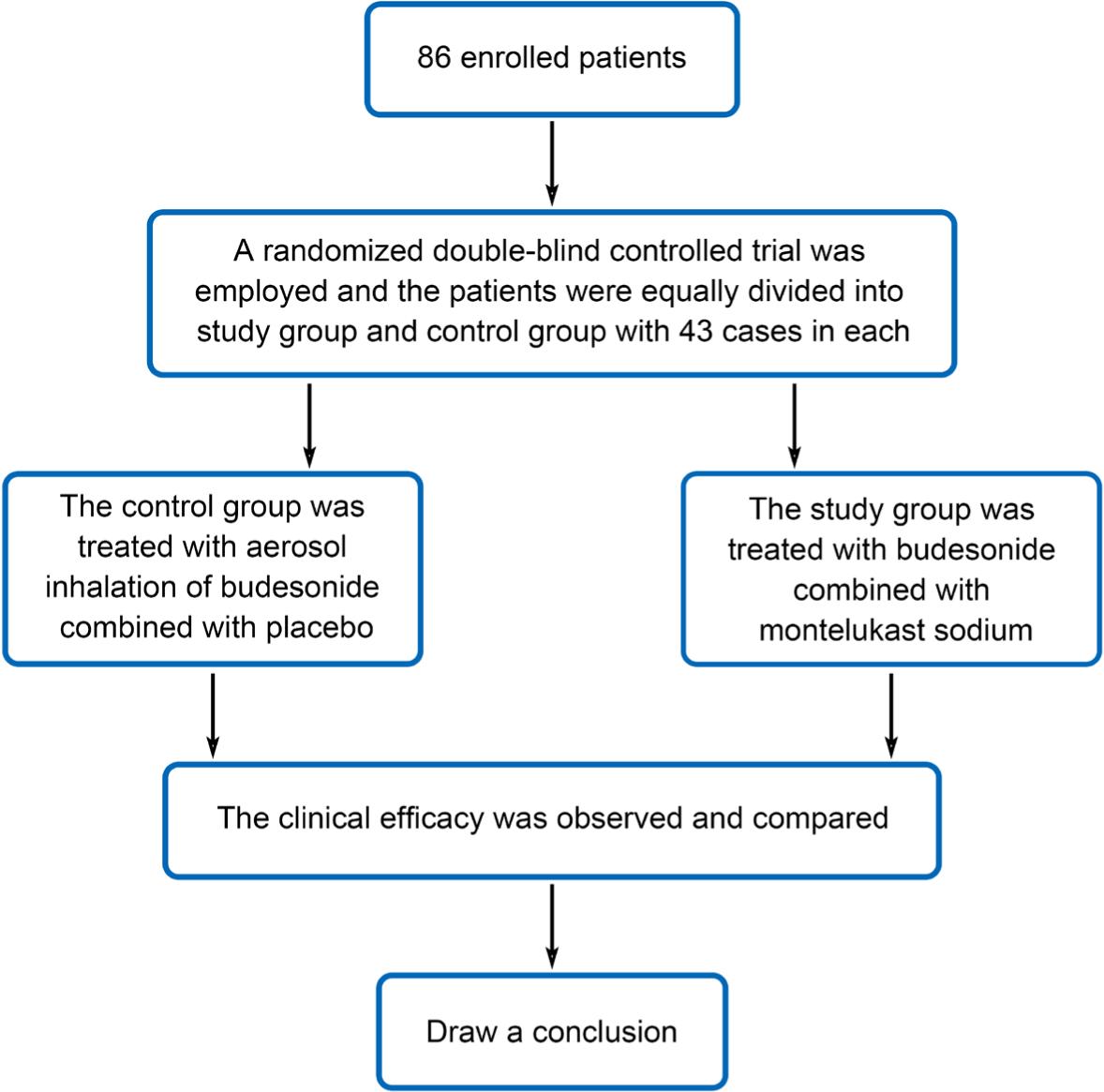
The concrete design flowchart is presented in Figure 1.
Figure 1 Design flowchart.
Statistical methods
SPSS 23.0 was utilized for statistical analysis of the study data, and the enumeration data were presented as n and %, and X2 test was applied for the comparison between groups. Measurement data were demonstrated as (x ± s), and t-test was adopted for the comparison of data. P less than 0.05 indicated that the differences were significant.
Results
Comparison of pulmonary function parameters between both groups
There was no discernible difference in any of the pulmonary function metrics across the two groups prior to treatment application (P > 0.05). After treatment, all pulmonary function parameters in both groups improved, and the study group was superior to the control group (P < 0.05) with a remarkable difference. The results are demonstrated in Table 2.
Table 2 Comparison of pulmonary function parameters between both groups (x̄_ ± s).
| Parameters | Before and after treatment | Study group (n = 43) | Control group (n = 43) | t | P |
|---|---|---|---|---|---|
| FEV1 (L) | Before treatment | 65.35 ± 5.16 | 65.41 ± 5.09 | 0.0543 | 0.9568 |
| After treatment | 75.26 ± 6.95 | 68.35 ± 6.21 | 4.8617 | 0.0000 | |
| T | 7.5073 | 2.401 | |||
| P | 0.0000 | 0.0186 | |||
| FVC (L) | Before treatment | 2.51 ± 0.21 | 2.52 ± 0.23 | 0.2105 | 0.8338 |
| After treatment | 3.46 ± 0.33 | 3.01 ± 0.29 | 6.7169 | 0.0000 | |
| T | 15.9262 | 8.681 | |||
| P | 0.0000 | 0.0000 | |||
| FEV1/FVC (%) | Before treatment | 55.16 ± 5.14 | 55.18 ± 5.09 | 0.0181 | 0.9856 |
| After treatment | 69.35 ± 6.09 | 61.08 ± 5.34 | 6.6954 | 0.0000 | |
| T | 11.6763 | 5.2444 | |||
| P | 0.0000 | 0.0000 | |||
| PEF (L/min) | Before treatment | 53.65 ± 5.34 | 53.71 ± 5.41 | 0.0518 | 0.9588 |
| After treatment | 64.95 ± 6.54 | 59.63 ± 6.04 | 3.9187 | 0.0002 | |
| T | 8.7762 | 4.7875 | |||
| P | 0.0000 | 0.0000 | |||
| MMEF | Before treatment | 4.23 ± 0.45 | 4.24 ± 0.46 | 0.1019 | 0.9191 |
| After treatment | 5.26 ± 0.51 | 5.00 ± 0.57 | 2.2291 | 0.0285 | |
| T | 9.9304 | 6.804 | |||
| P | 0.0000 | 0.0000 | |||
| MEF25% | Before treatment | 6.35 ± 0.64 | 6.37 ± 0.59 | 0.1507 | 0.8806 |
| After treatment | 8.16 ± 0.76 | 7.04 ± 0.65 | 7.344 | 0.0000 | |
| T | 11.9457 | 5.0049 | |||
| P | 0.0000 | 0.0000 | |||
| MEF50% | Before treatment | 4.75 ± 0.46 | 4.78 ± 0.49 | 0.2927 | 0.7705 |
| After treatment | 5.56 ± 0.54 | 5.09 ± 0.54 | 4.0357 | 0.0001 | |
| T | 7.4877 | 2.7878 | |||
| P | 0.0000 | 0.0066 | |||
| DLCO (mL/min/mmHg) | Before treatment | 17.12 ± 1.62 | 17.19 ± 1.59 | 0.2022 | 0.8402 |
| After treatment | 22.65 ± 2.14 | 19.35 ± 1.81 | 7.7207 | 0.0000 | |
| T | 13.5105 | 5.8792 | |||
| P | 0.0000 | 0.0000 | |||
| RV/TLC (%) | Before treatment | 39.21 ± 2.16 | 39.31 ± 2.09 | 0.2182 | 0.8278 |
| After treatment | 53.25 ± 4.26 | 47.25 ± 4.11 | 6.6467 | 0.0000 | |
| T | 19.2756 | 11.292 | |||
| P | 0.0000 | 0.0000 |
Comparison of immunoglobulin indicators between both groups
Before treatment, there was no eminent difference in immunoglobulin indicators between both groups (P > 0.05). After treatment, all immunoglobulin indicators in the two groups improved, and the study group was superior to the control group (P < 0.05) with significant difference. The results are revealed in Table 3.
Table 3 Comparison of immunoglobulin indicators between both groups (x̄ ± s).
| Indicators | Before and after treatment | Study group (n = 43) | Control group (n = 43) | t | P |
|---|---|---|---|---|---|
| IgA (g/L) | Before treatment | 1.09 ± 0.12 | 1.10 ± 0.11 | 0.4028 | 0.6881 |
| After treatment | 2.09 ± 0.19 | 1.58 ± 0.15 | 13.8151 | 0.0000 | |
| T | 29.1802 | 16.9214 | |||
| P | 0.0000 | 0.0000 | |||
| IgG (g/L) | Before treatment | 10.86 ± 1.05 | 10.89 ± 1.06 | 0.1319 | 0.8954 |
| After treatment | 17.06 ± 1.25 | 13.25 ± 1.19 | 14.4762 | 0.0000 | |
| T | 24.9045 | 9.7108 | |||
| P | 0.0000 | 0.0000 | |||
| IgM (g/L) | Before treatment | 1.05 ± 0.12 | 1.06 ± 0.13 | 0.3706 | 0.7118 |
| After treatment | 1.49 ± 0.19 | 1.29 ± 0.18 | 5.0109 | 0.0000 | |
| T | 12.8393 | 6.7926 | |||
| P | 0.0000 | 0.0000 | |||
| IgE (g/L) | Before treatment | 201.25 ± 21.35 | 202.14 ± 20.16 | 0.1988 | 0.8429 |
| After treatment | 154.35 ± 14.69 | 188.35 ± 17.65 | 9.709 | 0.0000 | |
| T | 11.8671 | 3.3748 | |||
| P | 0.0000 | 0.0011 |
Comparison of symptom recovery between both groups
The recovery time of related symptoms in study group was shorter than that in control group (P < 0.05), and the difference was prominent. The results are shown in Table 4.
Table 4 Comparison of symptom recovery between both groups [d, (x̄ ± s)].
| Group | Case | Wheezing disappeared | Wheezing rale disappeared | Cough disappeared | Dyspnea disappeared |
|---|---|---|---|---|---|
| Study group | 43 | 5.21 ± 0.51 | 7.56 ± 0.63 | 5.26 ± 0.49 | 7.44 ± 0.63 |
| Control group | 43 | 6.98 ± 0.67 | 9.98 ± 0.94 | 7.56 ± 0.59 | 9.67 ± 0.81 |
| T | 13.725 | 14.0236 | 19.6653 | 14.2503 | |
| P | 0.0000 | 0.0000 | 0.0000 | 0.0000 |
Comparison of adverse reactions between both groups
There was one case of sleep disorder in the study group, but the degree was mild. The patient recovered rapidly after drug withdrawal. There was one case of respiratory symptoms in the control group, which manifested as a hoarse voice. The degree was also mild, and the patient recovered rapidly after drug withdrawal. There was no significant difference in the incidence of adverse reactions between both groups (X2 = 0.0000, P = 1.0000).
Discussion
Clinical studies have suggested that T lymphocytes, eosinophils, and other related inflammatory cells play an essential role in the development of childhood asthma.13,14 Children clinically manifest coughing, wheezing, dyspnea, and airway hyperreactivity. Besides, children are prone to recurrent and persistent attacks.15,16 The main triggers of the disease in children are exposure to allergens, non-specific stimulation, as well as emotional and weather changes. As confirmed by clinical practice, effective treatments for children with bronchial asthma mainly include drug therapy, traditional Chinese medicine treatment, anti-IgE monoclonal antibodies, anti-tumor necrosis factor, and bronchial thermoplasty.17,18
Drug therapy remains the dominant treatment employed in clinical practice. The optimal drugs in drug therapy are glucocorticoids.19 These medications significantly reduce the inflammatory effects associated with bronchial asthma. Budesonide is one of the most widely used glucocorticoids.20 It can effectively promote the efficacy of endogenous glucocorticoids, inhibit the inflammatory response in the respiratory tract of children, and then fully inhibit the activity of IgE. Hence, budesonide can achieve the dual efficacy of anti-allergy in the process of anti-inflammation.21 However, atomization inhalation is the most efficient method of delivery due to the drug’s significant hepatic first-pass effect.
Nonetheless, clinical trials have confirmed22,23 that increasing the dose of the budesonide in children does not produce a synchronous improvement in efficacy. When budesonide reached 800 μg/d, the efficacy was not improved by adding atomization inhalation, and the adverse reactions of the children showed an increasing trend. Since budesonide cannot directly affect leukotriene-mediated processes, as suggested by multiple studies, it has demonstrated inadequate clinical effectiveness in reducing leukotriene-mediated inflammatory reactions.24,25 Meanwhile, long-term use of budesonide in children easily leads to osteoporosis, decreased adrenocortical function, and other adverse reactions. Therefore, the clinical efficacy of this drug is limited.
Montelukast sodium, as a non-hormonal anti-inflammatory drug, can bind to cysteinyl leukotriene receptors, participate in leukotriene-mediated processes, and block their activity, fundamentally inhibiting the production of leukotrienes, which compensates for the disadvantages of budesonide.26,27 The integration of the two can complement each other, exert synergistic effects, and enhance clinical efficacy.28 Therefore, the combination of the two in treating children with bronchial asthma achieved better results.
In accordance with clinical investigations, asthmatic children’s pulmonary function is significantly decreased compared to children without the condition. This is mainly characterized by the reduced ability of the large and small airways in children. The data of this study showed that before treatment, there was no conspicuous difference in all pulmonary function parameters between both groups (P > 0.05); after treatment, all pulmonary function parameters in both groups increased, and the study group was superior to the control group with a significant difference (P < 0.05). This result disclosed that, compared with aerosol inhalation of budesonide alone, oral administration of montelukast sodium in children with asthma can efficiently promote the synchronous improvement of large and small airway function in children. Montelukast sodium enhances the clinical efficacy of budesonide and further boosts the efficacy of drugs to improve airway function.29
In terms of immune indicators, the data of this study showed that after treatment, all immunoglobulin indicators in the two groups were promoted, and the study group was statistically and significantly superior to the control group (P < 0.05). It was concluded that the integration of drugs was conducive to the recovery of immune capacity in children. It mainly benefits from the enhanced inhibitory effect of montelukast sodium on leukotrienes, which reduces the destructive impact of leukotrienes on the immune system, improves immune capacity, and effectively promotes the rehabilitation of children.30,31 This result is consistent with similar reports at home and abroad. In this study, we also found that the recovery time of related symptoms in the study group was shorter than that in the control group (P < 0.05), and the difference was prominent. This result further validates the above notion.32,33
With the deepening of asthma-related research, the focus of treatment has changed from relieving bronchospasm, anti-allergy, and anti-infection to comprehensive treatment based on the prevention and treatment of airway inflammation. Respiratory rehabilitation is a critical part of comprehensive treatment, which can not only improve the pulmonary function of children with asthma, promote improved exercise capacity, asthma control level, and quality of life, but also reduce the need for drug use to treat the severity of asthma in children. However, asthma in children features diverse inducements, recurrent attacks, and reversibility. Besides, some children are younger and cannot master various training methods well in a short period of time, which requires long-term, continuous, and standardized treatment and care. The longer the rehabilitation time, the more obvious the effect. Therefore, for clinical medical staff, it is feasible to improve the rehabilitation compliance of children and promote healthy behaviors through the Internet or door-to-door follow-up in the community.
In brief, the use of budesonide combined with montelukast sodium in the treatment of bronchial asthma can considerably improve the pulmonary function of children, enhance the protective potential of the immune system, and promote the early recovery of children. These elements have valuable clinical applications. Given that the cases in this study were derived from the same hospital and the sources were relatively single, the study had some limitations. In the next step, the study of budesonide combined with montelukast sodium in the treatment of bronchial asthma should further expand the scope of study subjects to verify the scientificity and effectiveness of the treatment.
Acknowledgements
Not applicable.
Funding
No funding was used in this study.
Competing Interests
The authors state that there are no conflicts of interest to disclose.
Ethics Approval
Ethical approval was obtained from the Ethics Committee of Anhui Provincial Children’s Hospital (Approval no. EYLL-2022010).
Consent to Participate Statement
Written informed consent was obtained from a legally authorized representative(s) for anonymized patient information to be published in this article.
Data Availability
The authors declare that all data supporting the findings of this study are available within the paper and any raw data can be obtained from the corresponding author upon request.
Contribution of Authors
Fangfang Chu and Lei Liang designed the study and carried them out, supervised the data collection, analyzed the data, interpreted the data. Fangfang Chu, Lei Liang, and Fuzhe Chen prepared the manuscript for publication and reviewed the draft of the manuscript. All authors have read and approved the manuscript.
REFERENCES
1. Koefoed HJL, Zwitserloot AM, Vonk JM, Koppelman GH. Asthma, bronchial hyperresponsiveness, allergy and lung function development until early adulthood: a systematic literature review. Pediatr Allergy Immunol. 2021;32(6):1238–1254. 10.1111/pai.13516
2. Song Y, Wang Z, Jiang J, Piao Y, Li L, Xu C, et al. DEK-targeting aptamer DTA-64 attenuates bronchial EMT-mediated airway remodelling by suppressing TGF-β1/Smad, MAPK and PI3K signalling pathway in asthma. J Cell Mol Med. 2020;24(23):13739–13750. 10.1111/jcmm.15942
3. Zhou XJ, Qin Z, Lu J, Hong JG. Efficacy and safety of salmeterol/fluticasone compared with montelukast alone (or add-on therapy to fluticasone) in the treatment of bronchial asthma in children and adolescents: a systematic review and meta-analysis. Chin Med J (Engl). 2021;134(24):2954–2961. 10.1097/CM9.0000000000001853
4. Varricchi G, Modestino L, Poto R, Cristinziano L, Gentile L, Postiglione L, et al. Neutrophil extracellular traps and neutrophil-derived mediators as possible biomarkers in bronchial asthma. Clin Exp Med. 2022;22(2):285–300. 10.1007/s10238-021-00750-8
5. Ravi A, Goorsenberg AWM, Dijkhuis A, Dierdorp BS, Dekker T, van Weeghel M, et al. Metabolic differences between bronchial epithelium from healthy individuals and patients with asthma and the effect of bronchial thermoplasty. J Allergy Clin Immunol. 2021;148(5):1236–1248. 10.1016/j.jaci.2020.12.653
6. Chaudhuri R, Rubin A, Sumino K, Lapa ESJR, Niven R, Siddiqui S, et al. Safety and effectiveness of bronchial thermoplasty after 10 years in patients with persistent asthma (BT10+): a follow-up of three randomised controlled trials. Lancet Respir Med. 2021;9(5):457–466. 10.1016/S2213-2600(20)30408-2
7. Nalini CN, Kumar V. A review of different analytical techniques for fexofenadine hydrochloride and montelukast sodium in different matrices. Crit Rev Anal Chem. 2021;51(3):232–245. 10.1080/10408347.2019.1709410
8. Li W, Wang Y, Pei Y, Xia Y. Pharmacokinetics and bioequivalence evaluation of two montelukast sodium chewable tablets in healthy Chinese volunteers under fasted and fed conditions. Drug Design Dev Ther. 2021;15:1091–1099. 10.2147/DDDT.S298355
9. Jin W, Zhao Z, Zhou D. Effect of montelukast sodium combined with budesonide aerosol on airway function and T lymphocytes in asthmatic children. Pak J Med Sci. 2022;38(5):1265–1270. 10.12669/pjms.38.5.5749
10. Dai W, Zhen N, Qin X, Cao J. Effect of momethasone furoate combined with loratadine and montelukast sodium on inflammatory factors and pulmonary function in children with allergic rhinitis. Am J Transl Res. 2022;14(10):7199–7207.
11. Chen L, Huang M, Xie N. The effect of montelukast sodium plus budesonide on the clinical efficacy, inflammation, and pulmonary function in children with cough variant asthma. Am J Transl Res. 2021;13(6):6807–6816.
12. Zhang Y, Li B. Effects of montelukast sodium plus budesonide on lung function, inflammatory factors, and immune levels in elderly patients with asthma. Ir J Med Sci. 2020;189(3):985–990. 10.1007/s11845-019-02167-5
13. Asayama K, Kobayashi T, D’Alessandro-Gabazza CN, Toda M, Yasuma T, Fujimoto H, et al. Protein S protects against allergic bronchial asthma by modulating Th1/Th2 balance. Allergy. 2020;75(9):2267–2278. 10.1111/all.14261
14. Goorsenberg AWM, d’Hooghe JNS, Srikanthan K, Ten Hacken NHT, Weersink EJM, Roelofs J, et al. Bronchial thermoplasty induced airway smooth muscle reduction and clinical response in severe asthma. The TASMA randomized trial. Am J Respir Crit Care Med. 2021;203(2):175–184. 10.1164/rccm.201911-2298OC
15. Mandlik DS, Mandlik SK. New perspectives in bronchial asthma: pathological, immunological alterations, biological targets, and pharmacotherapy. Immunopharmacol Immunotoxicol. 2020;42(6):521–544. 10.1080/08923973.2020.1824238
16. Rybka-Fraczek A, Dabrowska M, Grabczak EM, Bialek-Gosk K, Klimowicz K, Truba O, et al. Does bronchial hyperresponsiveness predict a diagnosis of cough variant asthma in adults with chronic cough: a cohort study. Respir Res. 2021;22(1):252. 10.1186/s12931-021-01845-2
17. Wijsman PC, Goorsenberg AWM, Ravi A, d’Hooghe JNS, Dierdorp BS, Dekker T, et al. Airway inflammation before and after bronchial thermoplasty in severe asthma. J Asthma Allergy. 2022;15:1783–1794. 10.2147/JAA.S383418
18. Minagawa S, Araya J, Watanabe N, Fujimoto S, Watanabe J, Hara H, et al. Real-life effectiveness of dupilumab in patients with mild to moderate bronchial asthma comorbid with CRSwNP. BMC Pulm Med. 2022;22(1):258. 10.1186/s12890-022-02046-3
19. Allam V, Paudel KR, Gupta G, Singh SK, Vishwas S, Gulati M, et al. Nutraceuticals and mitochondrial oxidative stress: bridging the gap in the management of bronchial asthma. Environ Sci Pollut Res Int. 2022;29(42):62733–62754. 10.1007/s11356-022-21454-w
20. Diaz MA, Catalan-Caceres N, Beauperthuy TC, Domingo C, Ibañez E, Morata C, et al. Clinical features and outcomes associated with bronchial asthma among COVID-19 hospitalized patients. J Asthma Allergy. 2022;15:775–781. 10.2147/JAA.S354082
21. Lee GKC, Beeler-Marfisi J, Viel L, Piché É, Kang H, Sears W, et al. Bronchial brush cytology, endobronchial biopsy, and SALSA immunohistochemistry in severe equine asthma. Vet Pathol. 2022;59(1):100–111. 10.1177/03009858211048635
22. Feng KN, Meng P, Zou XL, Zhang M, Li HK, Yang HL, et al. IL-37 protects against airway remodeling by reversing bronchial epithelial-mesenchymal transition via IL-24 signaling pathway in chronic asthma. Respir Res. 2022;23(1):244. 10.1186/s12931-022-02167-7
23. Castro M, Chupp G. 2020 Updated asthma guidelines: bronchial thermoplasty in the management of asthma. J Allergy Clin Immunol. 2021;147(5):1638–1639. 10.1016/j.jaci.2021.02.024
24. Valladales-Restrepo LF, Saavedra-Navia JC, Montezuma-Casanova CA, Montañez-Díaz V, González-Ospina JA, Caballero-Martínez LM, et al. Satisfaction with and use of inhalation devices in patients with bronchial asthma. J Aerosol Med Pulm Drug Deliv. 2022;35(6):313–320. 10.1089/jamp.2022.0027
25. Saad EA, Elsaid AM, Shoaib RMS, Megahed KF, Elsharawy AN. MUC7 VNTR polymorphism and association with bronchial asthma in Egyptian children. Sci Rep. 2022;12(1):18910. 10.1038/s41598-022-21631-4
26. Prajapati P, Tamboli J, Surati P, Mishra A. Risk assessment-based enhanced analytical quality-by-design approach to eco-friendly and economical multicomponent spectrophotometric methods for simultaneous estimation of montelukast sodium and bilastine. J AOAC Int. 2021;104(5):1453–1463. 10.1093/jaoacint/qsab089
27. Ranjan OP, Kumar N, Dave V. Cross-linked alginate beads of montelukast sodium coated with eudragit for chronotherapy: statistical optimization, in vitro and in vivo evaluation. Curr Drug Deliv. 2022;19(10):1047–1060. 10.2174/1567201819666220221091542
28. Zheng Q, Ma D, Zhu Q, Tang S, Chen C. Effect of azelastine hydrochloride combined with montelukast sodium in the treatment of patients with allergic rhinitis. Am J Transl Res. 2021;13(8):9570–9577.
29. Azizoglu E, Ozer O, Prausnitz MR. Fabrication of pure-drug microneedles for delivery of montelukast sodium. Drug Deliv Transl Res. 2022;12(2):444–458. 10.1007/s13346-021-01047-9
30. Naqi SA, Ashfaq AH, Umar MA, Karmani JK, Arshad N. Clinical outcome of montelukast sodium in children with adenoid hypertrophy. Pak J Med Sci. 2021;37(2):362–366. 10.12669/pjms.37.2.2670
31. Zhu G, Wang L, Han S, Peng H, Tong M, Gu X, et al. Pharmacokinetics and bioequivalence study of montelukast sodium oral soluble film and chewable tablet in healthy Chinese volunteers: randomized trials under fasting and fed conditions. Ann Transl Med. 2023;11(2):93. 10.21037/atm-22-6485
32. Prajapati P, Tamboli J, Mishra A. Risk and DoE-based analytical failure mode effect analysis (AFMEA) to simultaneous estimation of montelukast sodium and bilastine by HPTLC method using enhanced AQbD approach. J Chromatogr Sci. 2022;60(6):595–605. 10.1093/chromsci/bmab107
33. Nashed D, Noureldin I, Sakur AA. New pencil graphite electrodes for potentiometric determination of fexofenadine hydrochloride and montelukast sodium in their pure, synthetic mixtures, and combined dosage form. BMC Chem. 2020;14(1):60. 10.1186/s13065-020-00716-z